Estimating Malaria Mobility in Mozambique

An infected traveler can carry malaria parasites from one region to another. In Mozambique, we used aggregated mobile-network data to estimate how often those movements occurred and where they might take the parasite.

The dataset contained pseudonymized and aggregated call-detail records from more than 8.5 million mobile subscribers between February and May 2017. We used each subscriber's last recorded location of the day as a proxy for where they spent the night, scaled the sample with WorldPop population estimates, and combined movement patterns with malaria-prevalence maps. This produced estimated parasite importation and exportation rates for 139 districts.

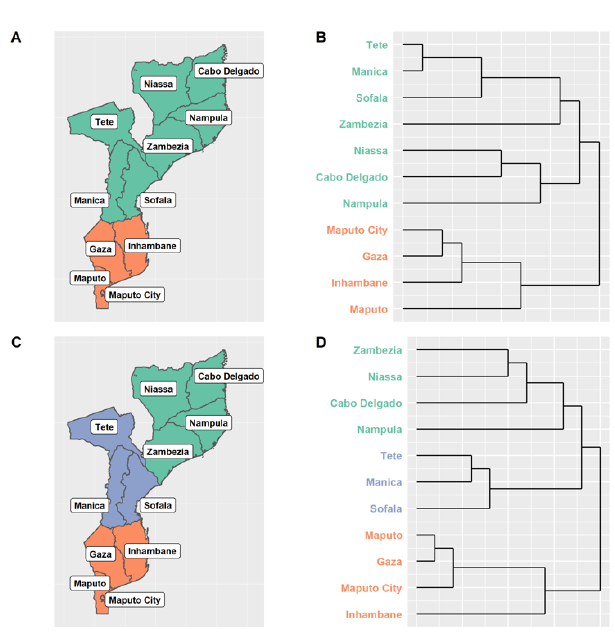
The districts with the highest malaria prevalence were not necessarily those with the most estimated parasite movement, and importation and exportation varied across the four months. The network of all human travel formed two broad regional groups, while estimated parasite movement formed three. Most movement in both networks was rural to rural, but the share of estimated parasite movement from rural to urban areas was 2.3 times the corresponding share of all human movement.

Our analysis estimated parasite movement rather than observing infections during travel. It covered only four months, so it could not capture a full year of seasonal variation, and the last location recorded each day was only a proxy for an overnight stay.

For this work, we collaborated with Mozambique's National Malaria Control Programme, the Clinton Health Access Initiative, and WorldPop at the University of Southampton. The Bill & Melinda Gates Foundation supported the project.

Maps and branching diagrams compare patterns of human travel with the movement of malaria parasites between Mozambican provinces.

Human travel formed two broad regional groups, while estimated parasite movement formed three.

Publication

Journal paper
Cite
Formatted citation

Jessica R. Floyd, Pedro Rente Lourenco, Nick W. Ruktanonchai, Andrew J. Tatem, Nuria Oliver (2019). Estimating Malaria Parasite Mobility in Mozambique Using Mobile Phone Records. American Journal of Tropical Medicine and Hygiene 101, 523-523.

BibTeX
@article{floyd2019malaria,
  author = {Jessica R. Floyd and Pedro Rente Lourenco and Nick W. Ruktanonchai and Andrew J. Tatem and Nuria Oliver},
  title = {Estimating Malaria Parasite Mobility in Mozambique Using Mobile Phone Records},
  journal = {American Journal of Tropical Medicine and Hygiene},
  volume = 101,
  pages = {523--523},
  year = 2019
}

Estimating Malaria Parasite Mobility in Mozambique Using Mobile Phone Records

Jessica R. Floyd, Pedro Rente Lourenco, Nick W. Ruktanonchai, Andrew J. Tatem, Nuria Oliver
American Journal of Tropical Medicine and Hygiene · 2019
Conference paper
PDF DOI
Cite
Formatted citation

Jessica R. Floyd, Pedro Rente Lourenço, Nick W. Ruktanonchai, Andrew J. Tatem, James M. Colborn, Baltazar Candrinho, Nuria Oliver (2020). Malaria Parasite Mobility in Mozambique Estimated Using Mobile Phone Records. Proceedings of the European Conference on Artificial Intelligence (ECAI 2020). https://doi.org/10.3233/faia200444

BibTeX
@inproceedings{floyd2020malaria,
  author = {Jessica R. Floyd and Pedro Rente Lourenço and Nick W. Ruktanonchai and Andrew J. Tatem and James M. Colborn and Baltazar Candrinho and Nuria Oliver},
  title = {Malaria Parasite Mobility in Mozambique Estimated Using Mobile Phone Records},
  booktitle = {Proceedings of the European Conference on Artificial Intelligence (ECAI 2020)},
  address = {Santiago de Compostela, Spain},
  year = 2020,
  doi = {10.3233/faia200444},
  file = {/projects/malaria-mobility-mozambique/malaria-mobility-mozambique.pdf},
  cites = 0,
  citesdate = {2026-03-23}
}

Malaria Parasite Mobility in Mozambique Estimated Using Mobile Phone Records

Jessica R. Floyd, Pedro Rente Lourenço, Nick W. Ruktanonchai, Andrew J. Tatem, James M. Colborn, Baltazar Candrinho, Nuria Oliver
Proceedings of the European Conference on Artificial Intelligence (ECAI 2020) · 2020

More information