Mobile Money: Understanding and Predicting Adoption

Mobile money services such as M-Pesa enable people to send, receive, and store money using a mobile phone. We studied whether patterns in anonymized mobile-phone data could help explain who adopted M-Pesa and how they used it.

We combined two pseudonymized datasets from different three-month periods: more than 140 million call and SMS records from a random sample of 100,000 customers, and about 27 million M-Pesa transactions from more than 1.2 million customers. Our models used phone activity, the M-Pesa agent network, the number of M-Pesa users in each customer's communication network, mobility, and geographic context.

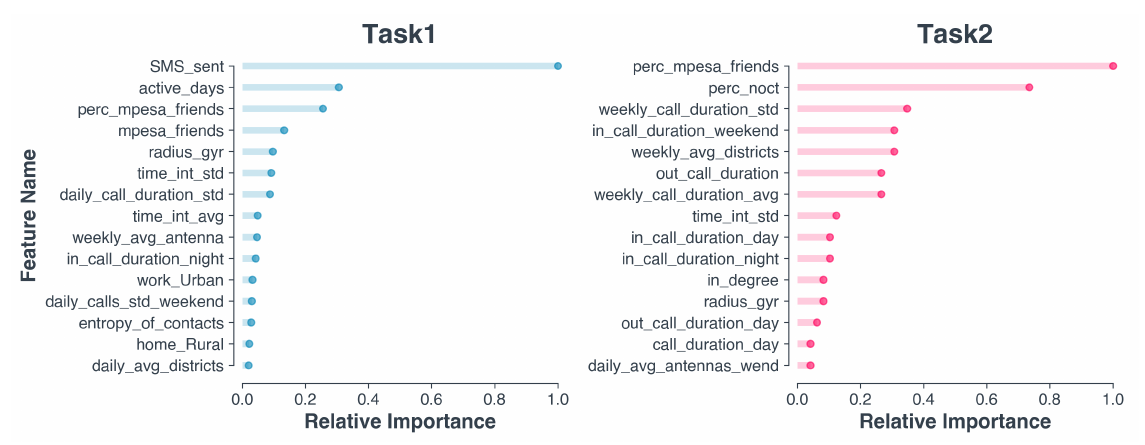
Past phone behavior predicted whether a registered customer would use M-Pesa three months later with an area under the curve (AUC) of 0.691. A second model distinguished customers in the highest and lowest spending quartiles with an AUC of 0.619. Phone activity, including active days and sent messages, and the presence of M-Pesa users in a customer's communication network were among the strongest predictors; mobility also contributed.

Our results describe predictive associations, not reasons why a person adopted or used M-Pesa. We used a random customer sample from one unnamed African country, and the phone and transaction datasets were separated by three months. We therefore cautioned against assuming that the models would work for other populations, periods, or countries.

Two charts compare the mobile-phone and social-network signals most useful for predicting M-Pesa use and spending.

The most informative signals differed between predicting future M-Pesa use and predicting spending.

We carried out this research with colleagues at Vodafone Research, Vodafone Group, Fondazione Bruno Kessler, and the University of Trento.

Publication

Conference paper
PDF DOI
Cite
Formatted citation

Simone Centellegher, Giovanna Miritello, Daniel Villatoro, Devyani Parameshwar, Bruno Lepri, Nuria Oliver (2018). Mobile Money: Understanding and Predicting Its Adoption and Use in a Developing Economy. Proceedings of the ACM on Interactive, Mobile, Wearable and Ubiquitous Technologies 2(4), 1-18. https://doi.org/10.1145/3287035

BibTeX
@inproceedings{centellegher2018mobileadopt,
  author = {Simone Centellegher and Giovanna Miritello and Daniel Villatoro and Devyani Parameshwar and Bruno Lepri and Nuria Oliver},
  title = {Mobile Money: Understanding and Predicting Its Adoption and Use in a Developing Economy},
  booktitle = {Proceedings of the ACM on Interactive, Mobile, Wearable and Ubiquitous Technologies},
  volume = 2,
  number = 4,
  pages = {1--18},
  year = 2018,
  doi = {10.1145/3287035},
  file = {/projects/mobile-money-adoption/mobile-money-adoption.pdf},
  cites = 25,
  citesdate = {2026-03-23}
}

Mobile Money: Understanding and Predicting Its Adoption and Use in a Developing Economy

Simone Centellegher, Giovanna Miritello, Daniel Villatoro, Devyani Parameshwar, Bruno Lepri, Nuria Oliver
Proceedings of the ACM on Interactive, Mobile, Wearable and Ubiquitous Technologies · 2018
Conference paper
Cite
Formatted citation

Simone Centellegher, Giovanna Miritello, Daniel Villatoro, Devyani Parameshwar, Bruno Lepri, Nuria Oliver (2019). Understanding and Predicting Mobile Money Adoption and Use in a Developing Economy. Proceedings of the International Conference on Computational Social Science.

BibTeX
@inproceedings{centellegher2019mobile,
  author = {Simone Centellegher and Giovanna Miritello and Daniel Villatoro and Devyani Parameshwar and Bruno Lepri and Nuria Oliver},
  title = {Understanding and Predicting Mobile Money Adoption and Use in a Developing Economy},
  booktitle = {Proceedings of the International Conference on Computational Social Science},
  address = {Amsterdam, Netherlands},
  year = 2019
}

Understanding and Predicting Mobile Money Adoption and Use in a Developing Economy

Simone Centellegher, Giovanna Miritello, Daniel Villatoro, Devyani Parameshwar, Bruno Lepri, Nuria Oliver
Proceedings of the International Conference on Computational Social Science · 2019

More information