MobiSenseUs: Inferring Population Well-Being from Mobile Data

Measures of population well-being usually come from surveys and official statistics. Because they are costly to collect and not always updated frequently, MobiSenseUs tested whether aggregated patterns of mobile-phone use could complement them.

The analysis used privacy-preserving, aggregated data on mobility, application use, and communication from more than one million smartphone users in the United Kingdom; it did not include the content of calls or messages.

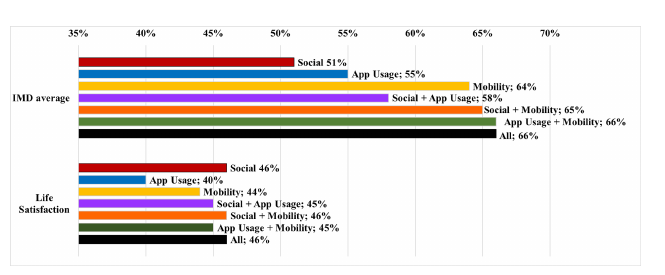
The models estimated the UK's Index of Multiple Deprivation more accurately than self-reported life satisfaction. That index includes income, employment, health, and education. Mobility patterns were most informative for deprivation, whereas communication patterns were more useful for life satisfaction.

Deprivation left a clearer signal in the mobile data than life satisfaction did. These patterns may complement surveys and public statistics, but they do not measure every aspect of well-being and cannot replace information collected directly from people.

A bar chart compares how accurately mobility, app-use, and communication signals estimated deprivation and life satisfaction.

Combining all three types of mobile behavior worked best for estimating deprivation, while communication signals performed best for life satisfaction.

Publication

Publication
PDF DOI
Cite
Formatted citation

Martin Hillebrand, Imran Khan, Filipa Peleja, Nuria Oliver (2020). MobiSenseUs: Inferring Aggregate Objective and Subjective Well-Being from Mobile Data. Proceedings of the European Conference on Artificial Intelligence (ECAI 2020). https://doi.org/10.3233/faia200297

BibTeX
@inproceedings{hillebrand2020mobisenseus,
  author = {Martin Hillebrand and Imran Khan and Filipa Peleja and Nuria Oliver},
  title = {{MobiSenseUs}: Inferring Aggregate Objective and Subjective Well-Being from Mobile Data},
  booktitle = {Proceedings of the European Conference on Artificial Intelligence (ECAI 2020)},
  address = {Santiago de Compostela, Spain},
  year = 2020,
  doi = {10.3233/faia200297},
  file = {/projects/mobisenseus/mobisenseus.pdf},
  cites = 8,
  citesdate = {2026-03-23}
}

MobiSenseUs: Inferring Aggregate Objective and Subjective Well-Being from Mobile Data

Martin Hillebrand, Imran Khan, Filipa Peleja, Nuria Oliver
Proceedings of the European Conference on Artificial Intelligence (ECAI 2020) ยท 2020

More information